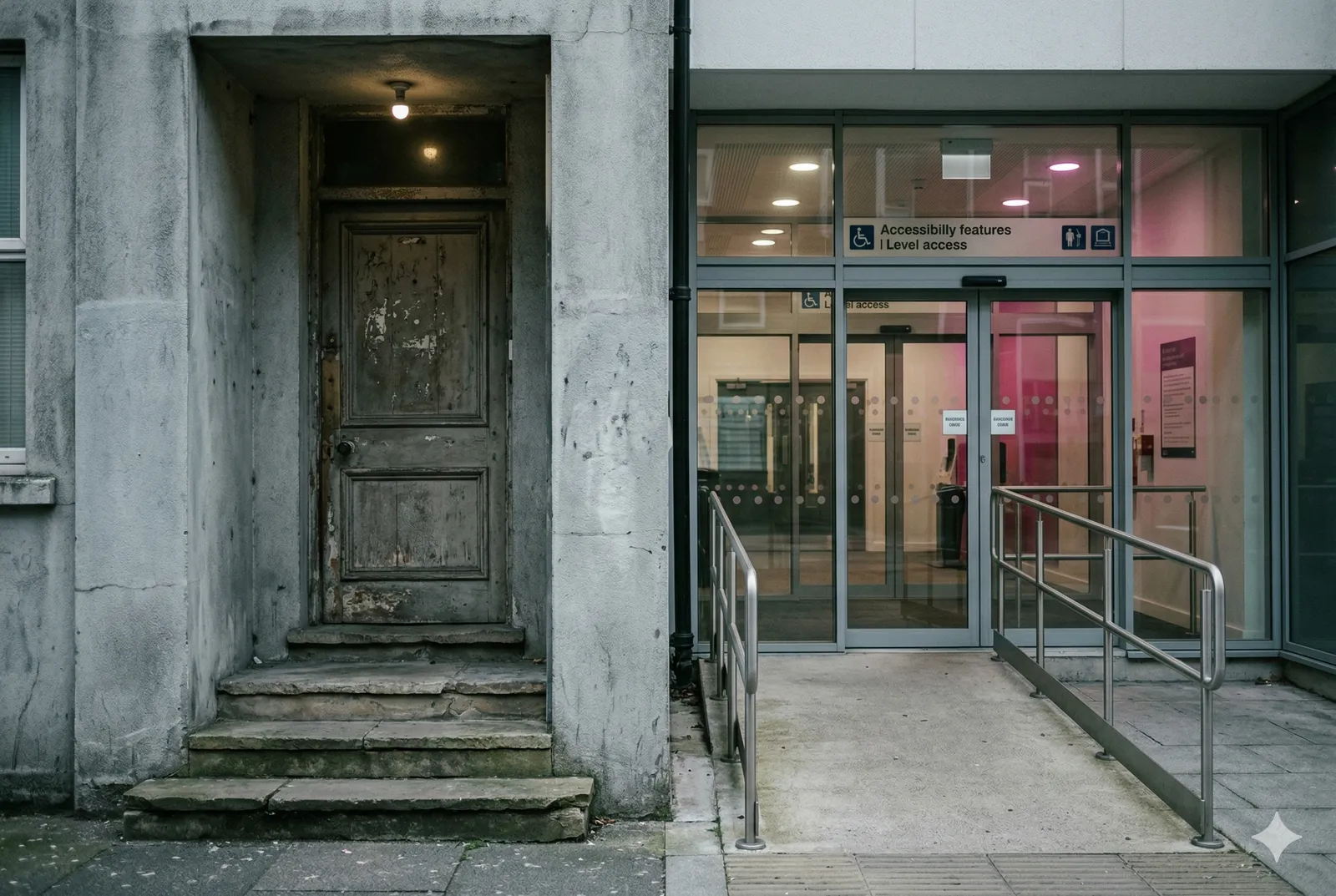
Most accessibility training gets it wrong.
They teach staff to 'help disabled people'. To be kind. To make allowances. To accommodate.
But that framing is the problem.
What is the social model of disability?
The social model of disability was first articulated in the 1970s by disabled activists in the UK, and formally named by academic Mike Oliver in 1983. It proposes a fundamental shift in how we think about disability.
The medical model says: the person has a problem. Their body or mind doesn't work 'properly', so they need help.
The social model says: the environment has a problem. Barriers exist that disable people, and those barriers can be removed.
This isn't semantics. It changes everything about how you approach accessibility.
The Union of the Physically Impaired Against Segregation (UPIAS) put it clearly in 1975: disability is something imposed on top of impairments by the way society unnecessarily isolates and excludes people from full participation. The person isn't the problem. The environment is.
What are the four types of accessibility barriers?
Barriers fall into four categories, and only one of them involves physical space:
**Physical barriers** are what most people think of first: steps, narrow doorways, heavy doors, inaccessible toilets, high counters. These matter, but they're only part of the picture.
**Communication barriers** include audio-only announcements, small print menus, staff who don't know how to communicate with Deaf customers, and information that's only available in one format.
**Attitudinal barriers** are often the most damaging. Staff who assume a wheelchair user can't make their own decisions. Managers who think accessibility is someone else's problem. The assumption that disabled people are a burden rather than customers.
**Environmental barriers** cover lighting, acoustics, sensory overload, temperature, and layout. A shop with fluorescent lighting and background music can be genuinely disabling for someone who is autistic or has sensory processing differences.
Every venue has barriers in all four categories. The question isn't whether they exist; it's whether you know about them and have a plan to address them.
A wheelchair user walks into a theatre
Under the medical model: 'This person can't walk, so they need our help getting to their seat.'
Under the social model: 'Our venue has steps. Steps are a barrier. How do we remove this barrier?'
In the first framing, the person is the problem. In the second, the steps are the problem. The wheelchair isn't a limitation. It's a mobility tool that gives someone independence. The steps are what's limiting.
This distinction plays out in hundreds of small interactions every day. When a Deaf customer approaches your reception desk, is the 'problem' that they can't hear? Or is the 'problem' that your communication systems assume everyone can?
Why this matters for your venue
When you train staff with a medical model mindset, you get:
When you train staff with a social model mindset, you get:
The legal framework: Equality Act 2010
The social model isn't just best practice. It's embedded in UK law.
The Equality Act 2010 places an 'anticipatory duty' on service providers. This means you can't wait until a disabled customer turns up and then try to figure it out. You're legally required to anticipate the barriers disabled customers might face and take reasonable steps to remove them in advance.
This is the social model in legislation. The law doesn't say 'help disabled people'. It says 'remove barriers before they arrive'.
Failure to make reasonable adjustments is discrimination under the Act. And the duty is anticipatory, meaning you can't argue that you didn't know. You should have anticipated it.
The dropped kerb effect
When kerbs were dropped at crossings to accommodate wheelchair users, an interesting thing happened. Parents with pushchairs found it easier. Delivery drivers with trolleys found it easier. Elderly people found it easier. Runners, cyclists, travellers with suitcases: all benefited.
This is the dropped kerb effect (known in some countries as the 'curb cut effect'). When you remove barriers for disabled people, you often improve things for everyone.
Clear signage helps people with visual impairments. It also helps people who don't speak English as a first language. Quiet hours benefit autistic customers. They also benefit anyone who finds shopping stressful. Staff trained to communicate clearly with Deaf customers are better communicators with everyone.
Accessibility isn't a niche concern. It's universal design that happens to start with the people who need it most.
What good looks like in practice
A venue operating on the social model doesn't just have a ramp and an accessible toilet. It has:
This is what WelcoMe was built for. When a customer shares their access requirements through WelcoMe Key before visiting, they're not 'warning' you about their disability. They're identifying barriers so you can remove them in advance.
No scrambling at the door. No awkward conversations. No well-meaning but unhelpful 'assistance'. Just a venue that's ready, and a customer who gets the same service as everyone else.
That's not charity. That's good business.
Further reading
Ready to train your team with the social model approach? Book a demo to see how WelcoMe works.